Hard Drive Slow Read and Write Speed
Many users are slowly migrating from using HDDs to SSDs, the reason is simple – SSDs start up a computer quickly. But slow SSD read/write speed bug are very much real. If your device contains a Solid-State Drive (SSD), yous possibly noticed that as it fills up, its functioning falls dramatically. You would discover that opening applications and copying files will accept longer than usual, and sometimes this will as well crusade freezing issues making your device tougher to apply.
SSD is the curt-form for a solid-state drive; information technology is a storage device that gained immense popularity in contempo times. Information technology adopts integrated excursion assemblies to aid people store data for good. Yet, several reasons tin can be responsible for deadening SSD read or write speed on Windows 10 or other operating systems, these include:
- Low Infinite
- TRIM command is disabled or doesn't exist
- AHCI mode is disabled
- The Boot sequence is incorrectly configured
- Computer or SSD is infected with viruses
- BIOS/firmware is outdated
- Something is wrong with the SATA port or cable
- Low RAM.
Amid others, these were the most common reasons for the declination in the speed and performance of the SSD.
TIP: Test your Read-Write speeds using CrystalDiskMark or Parkdale.
Slow SSD Read or Write Speed on Windows 11/x
It tin can be hard to pinpoint the exact problem that your system could exist facing, nosotros volition be listing down some tips that will hopefully get your SSD upward and running again.
- Free up space to amend performance
- Make sure the TRIM command is running
- Enable AHCI style
- Choose loftier-performance way
- Optimize your SSD
- Update Firmware of the SSD
- Configure correct Kick club
- Check your SATA port
- Bank check your SATA cable.
Let u.s. look at these solutions in more detail.
1] Free upwards space to improve performance
The less space on your SSD, the slower it will perform. If your SSD is at 90 percent capacity or higher, and yous notice some performance bug, at this bespeak y'all should first try and clear up some infinite. The most obvious thing that you can endeavor is to showtime deleting unnecessary files and folders from SSD that may be occupying the space.
Some other thought that works is to disable hibernation, as this could gratis up a lot of disk space for you. Follow these steps:
- Open 'Command Prompt' from 'Windows Search'.
- Blazon 'cmd'
- Right-click on the top search result and choose control prompt with authoritative rights i.e., select the pick 'Run equally administrator'
- Type 'powercfg -h off'
- Hitting 'Enter'
Once you followed the steps mentioned above to clear off some infinite in your SSD. Check if there have been any improvements in the SSD read/write speed. If it didn't work, motility on to the adjacent solution.
2] Brand certain the TRIM control is running
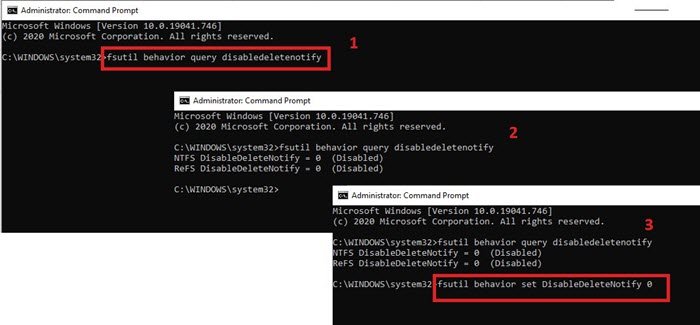
An SSD drive will run dull if the TRIM control is not running. Follow these steps to brand sure the TRIM is enabled.
- Click 'Outset' and type 'cmd'
- Right-click 'Command Prompt' and hit 'Open as Ambassador'
- Copy and paste the control – "fsutil beliefs query DisableDeleteNotify"
- Press 'Enter'
- Now, if you get '0' every bit the issue, it means TRIM is enabled and if you lot get '1' it ways disabled. Move on to the side by side stride if you become '0' in the event.
- Blazon fsutil beliefs fix DisableDeleteNotify 0
- Hit Enter.
This will enable TRIM command on your arrangement.
3] Enable AHCI mode
The Advanced Host Controller Interface (AHCI) specifies the performance of Series ATA (SATA) host controllers in a not-implementation-specific fashion in its motherboard chipsets. The specification describes a organization retentiveness structure for figurer hardware vendors to substitution data betwixt host system retention and attached storage devices. This style is very crucial for y'all to get the all-time out of the SSD; if it'south non enabled, your SSD will run slow. You can easily enable AHCI in Windows x.
iv] Cull the Power loftier-performance style
This is a quick potential fix. Endeavour changing to the Power high-performance fashion by post-obit the steps below:
1] Search for 'Power & Sleep settings' in the 'Get-go' bill of fare
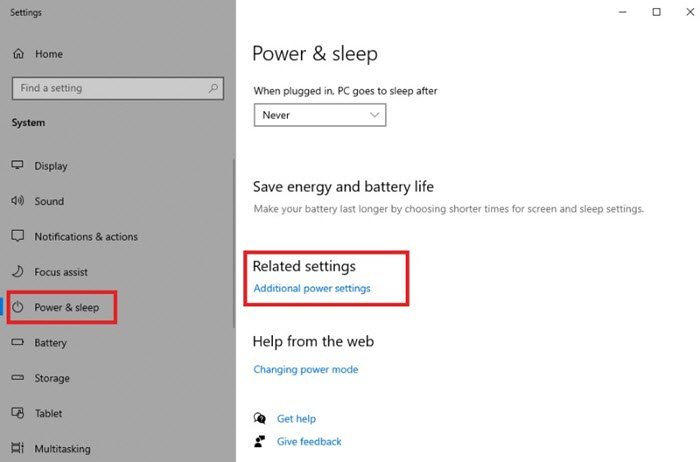
two] Scroll down the right-side options and click on 'Boosted ability settings' under 'related settings'
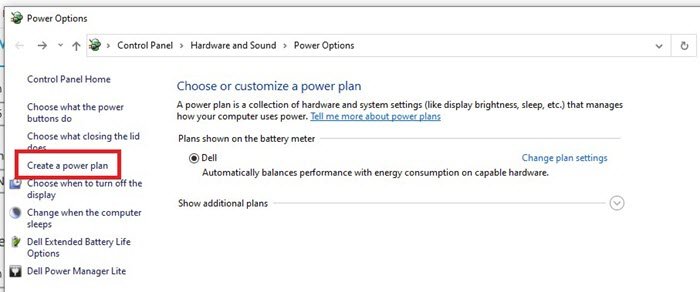
3] In the 'Power Options' window click on 'Create a power programme' actualization on the left-side menu
four] Now select 'High Operation' and click 'Adjacent'
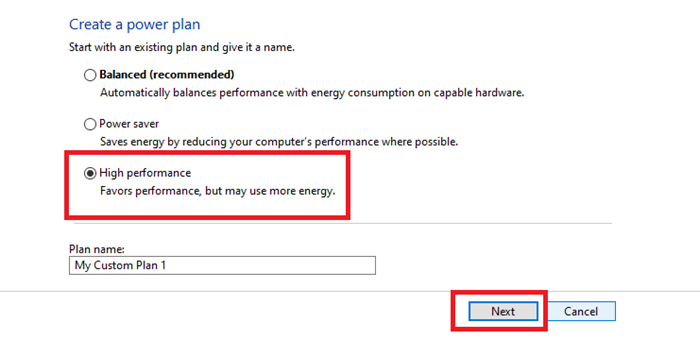
In Balanced Power Program, your SSD doesn't receive the total power it needs to run at its all-time chapters, on the other manus, the High-performance plan favors performance.
Read: Do you demand to defrag SSD?
5] Optimize your SSD
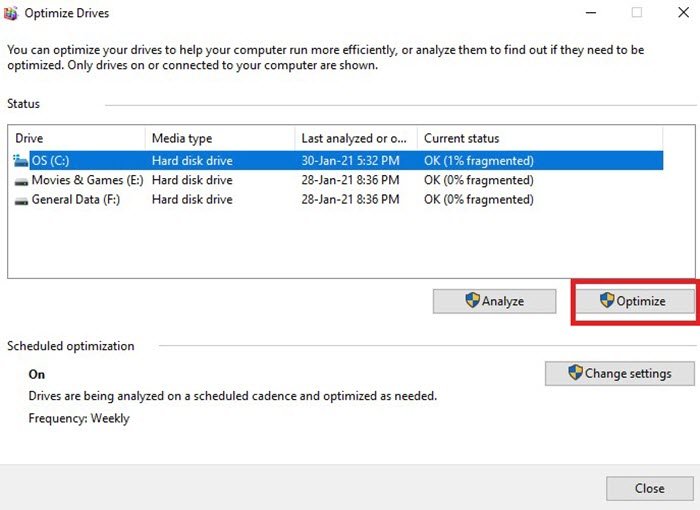
Subsequently some fourth dimension of using an SSD, particularly afterward installing many applications, it is recommended to optimize SSD. Follow these steps:
- Search for 'Defrag' in the 'Starting time bill of fare'
- Select Defragment and Optimize Drive
- Select the SSD drive and click 'Optimize'
Optimizing information technology from time to time helps bring information technology back to its original country.
Read: Optimize and speed up your SSD drive using Tweak-SSD.
6] Update Firmware of the SSD
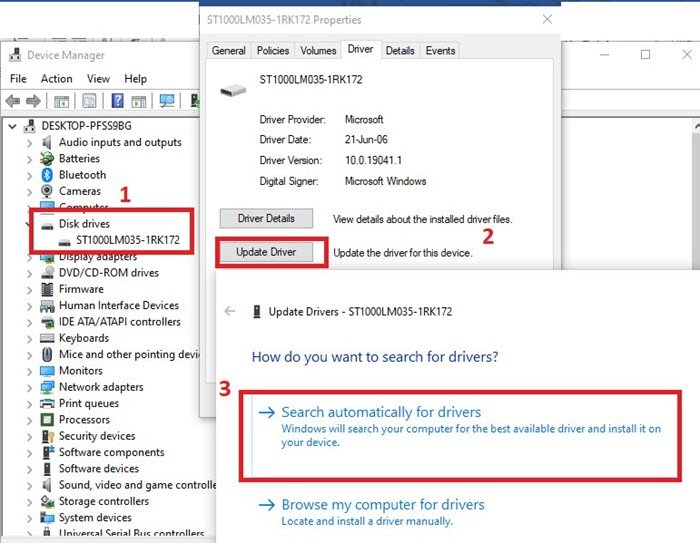
Just like other hardware, SSD manufacturers release patches and updates periodically for SSDs too. The firmware of SSDs is essential for running them smoothly and efficiently, and then remember to keep checking for a firmware update. To update your SSD, follow these steps:
- Press 'Win + R' keys to open up the 'Run' dialog box.
- In the 'Run' dialog, type 'devmgmt.msc'
- Hitting 'Enter'
- In the 'Device Manager' windows locate 'Disk drives' and click on the pointer and expand it.
- Right-click on the SSD and click 'Update Drivers'
- Yous will exist prompted for options on 'How do you want to search for drivers?' Click on 'Search automatically for drivers'.
Windows will now search for any new updates available for your SSD and install them. Once the procedure is completed. check if your issue is resolved.
vii] Configure correct Boot order
Another reason an SSD drive is boring could be that the kick sequence is wrongly configured. If the showtime priority is given to the hard drive, instead of SSD, the computer will run slow. This Windows guide will show how you lot tin boot into Windows 10 firmware settings (UEFI/BIOS), and change the boot order easily.
8] Bank check your SATA port
These days nigh motherboards contain SATA 3Gbps/ SATA 6Gbps ports. The speed of the port stands heavily on the SSD's performance. It tin can be hard to place the SATA Port, hence you must refer to the motherboard's manual to correctly determine it. Typically, motherboards made on Intel chipsets contain an Intel SATA controller. This controller specifically has the highest speed. So, the boot device should be connected to this i merely.
nine] Check your SATA cablevision
One more reason contributing to a poor SSD functioning is poor quality or defective SATA cable. So, have a cheque to confirm if the state of the cablevision is fine, also information technology is brash you purchase a SATA cable but from a well-known manufacturer.
Along with the above, you could try increasing your RAM or have a consummate format of your SSD – these tricks likewise help in fixing slow SSD read or write speed on Windows x.
Your SSD can go slow for various reasons, but when that happens human action immediately and rescue your data because the SSD may decadent at any time and you may lose all your valuable information.
Related read: How to increase Hard Bulldoze speed & amend performance.
Source: https://www.thewindowsclub.com/fix-slow-ssd-read-or-write-speed-on-windows-10
0 Response to "Hard Drive Slow Read and Write Speed"
Post a Comment